

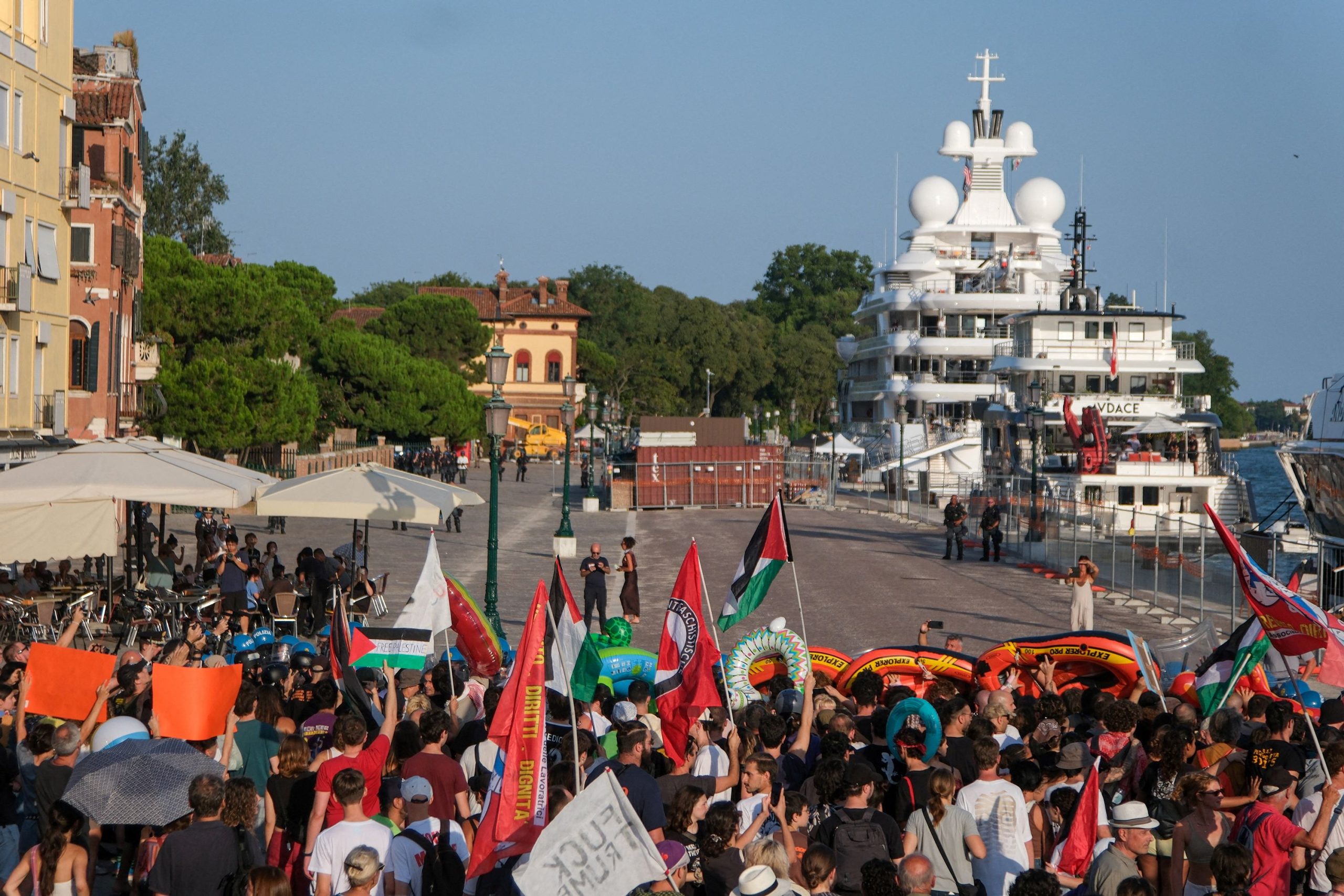
Too Big to Hide: Protest Is Now Part of the Voyage Plan
Superyachts have become a preferred stage for activism. The security implications go well beyond who is guarding the gangway.
In mid-July, several hundred protesters gathered on the Venice waterfront as Boardwalk, the 384-foot yacht of US Ambassador Tilman Fertitta, arrived as part of a coastal tour marking 250 years of American independence. Demonstrators carried a banner reading “Venezia non si USA” and briefly clashed with police as they neared the vessel. The story that made headlines afterwards was not really about the yacht. It was about the scale of the security presence her arrival required, and how that presence itself became part of the target.
Venice, in particular, has become something of a repeat venue for this kind of demonstration. Protesters gathered against Jeff Bezos’s high-profile wedding in the city the previous year on similar grounds, and returned in force for Fertitta’s arrival this July. Fertitta’s tour is one entry in a longer list beyond Venice, too. In March, the activist group Led By Donkeys tracked Musashi, the 288-foot yacht owned by Larry Ellison, to the French Riviera and attached lettering to her hull renaming her “The Trump Propagandist.” In 2023, activists in Ibiza used fire extinguishers loaded with biodegradable paint to cover the stern of a Walmart heiress’s yacht, and repeated the tactic on a vessel moored in Barcelona’s Port Vell weeks later. In London, campaigners have projected protest messages onto a $70 million superyacht berthed on the Thames after dark. The methods vary. The target does not.
Visibility Is the Vulnerability
What connects these actions is not proximity to a cause célèbre. It is that a superyacht is, structurally, very hard to hide. AIS transponder data is public by design, and commercial fleet trackers built for brokers and insurers work just as well for anyone trying to locate a specific hull. A yacht’s size, her berth, and often her owner’s identity are discoverable with an afternoon of open-source research. For activists, this makes a superyacht one of the more accessible symbols of wealth available to protest against. For security teams, it means the exposure starts long before the vessel reaches port.
Some owners respond by disabling AIS transmission for parts of a passage, a workaround with its own costs, including reduced visibility to other traffic and complications with port authorities who expect a transponder signal on approach. It reduces exposure. It does not eliminate it, and it introduces a different category of risk that has to be weighed against the one it is solving.
The Escalation Curve
Not every protest carries the same operational risk, and treating a banner and a boarding as the same category of event is a mistake in either direction. Demonstrations, banners, renamed hulls, and messages projected onto a berthed hull sit at one end of a spectrum that is symbolic, visible, and in most cases non-confrontational by design. Physical vandalism, of the kind seen in Ibiza and Barcelona, sits further along it. Actual boarding, while still rare, is the point at which a security response moves from monitoring and advance work to something closer to a standard incident response plan. Judging where a given situation sits on that curve, in real time, is one of the harder calls a security team makes, and it depends heavily on local intelligence gathered before the vessel ever arrives.
Crew as the First Line, Not the Front Line
How crew respond in the first minutes of an incident matters almost as much as the advance work that precedes it. A crew briefed to de-escalate, document, and hand off to shore-based security or local authorities tends to keep a protest a protest. A crew that responds to a paint canister or a banner with visible aggression risks turning a symbolic act into the more dramatic story, handing activists exactly the image they were hoping to capture. This is as much a training point as a security one, and it belongs in the same pre-departure briefing as any other safety drill.
When the Response Becomes the Story
A security posture that reads as heavy-handed can generate more negative coverage than the vessel would have attracted moored quietly. The Fertitta protest carries a lesson that is easy to miss under the politics of the moment. Reporting on the Venice demonstration focused as much on the disruption created by the security surrounding his arrival as on the ambassador himself. Proportionality is not a soft consideration here. It is a practical one, directly connected to how an incident is written up the next morning.
Building Protest Into Journey Management
None of this argues for a lighter approach to advance work. It argues for a more precise one. Journey management for a high-profile owner should now routinely include a read of local sentiment and planned activism at each port of call, alongside the standard threat assessment covering crime, terrorism and civil unrest. A short set of questions, worth running before any high-visibility port call, captures most of what matters:
- Is there a documented history of activism or protest at this port, or against this owner, in the last twelve months.
- Has the vessel’s AIS track, berth, or itinerary already surfaced publicly ahead of arrival.
- Is local port and law enforcement liaison in place, and briefed on the vessel’s profile.
- Does the crew have a clear, rehearsed process for the first ten minutes of a demonstration, boarding attempt, or vandalism.
Port liaison, calibrated crew briefings, and a response plan that separates a legitimate protest from an escalation into boarding or vandalism all belong in the same voyage plan as fuel logistics and berth confirmation.
A Different Kind of Exposure
None of this is really about politics, whatever the politics of any given protest happen to be. It is about scale. A vessel large enough to require her own security detail is, by the same measure, large enough to be found, named and photographed by anyone with an afternoon and an internet connection. That is simply the trade a certain size of yacht makes with visibility, and it applies whether the protest at the dockside concerns a diplomatic tour, a wedding, or a private jet parked nearby. The practical response is not to chase invisibility, which is neither realistic nor always desirable, but to plan properly for the moment visibility turns into a crowd.
Intelligence-led. Vetted. Proportionate.
If a forthcoming voyage or port call carries reputational or activism-related exposure and you would like it built into your journey management plan, contact our team at enquiries@priavosecurity.com